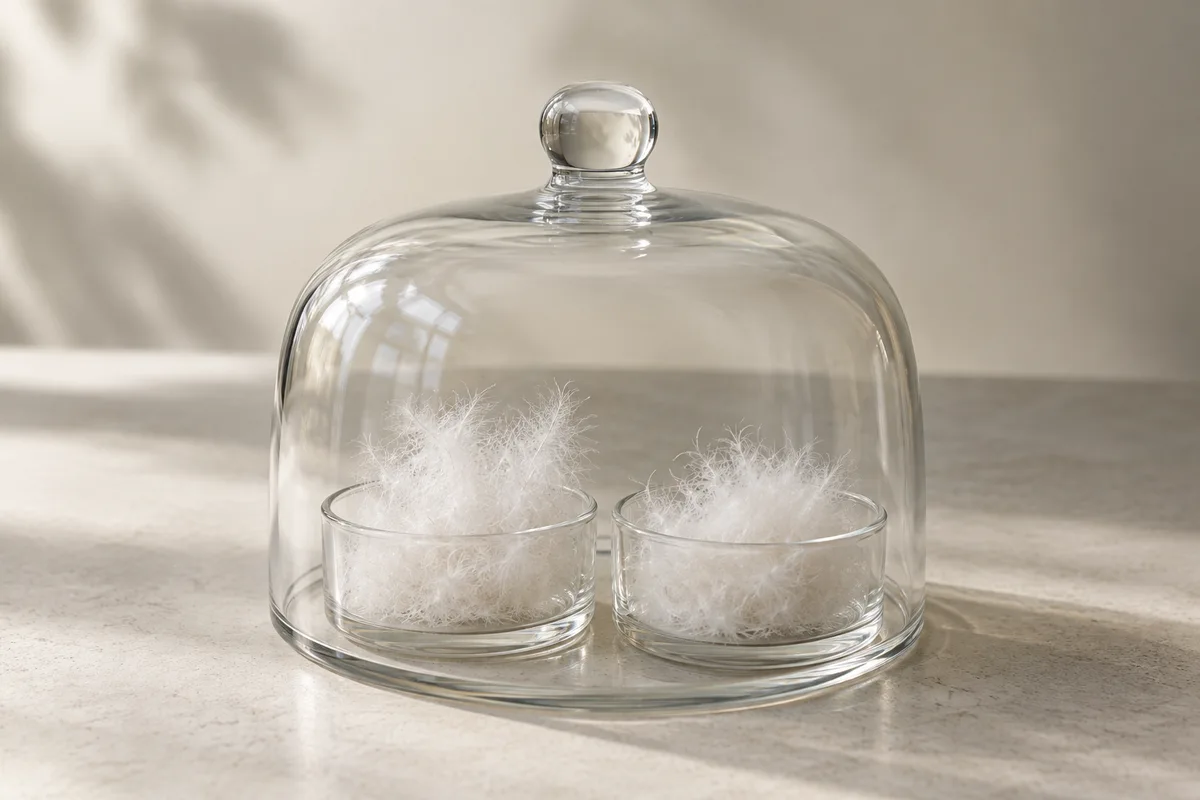
Before requesting a sample: define the decision
Start with the question the sample needs to answer: material selection, laboratory qualification or approval for a specific construction. A small comparison sample and filling for a prototype serve different purposes. Tell the supplier which stage you are at, and identify who will review the results across Purchasing, Development and Quality.
At CircuDown, recycled down samples are a starting point for B2B sourcing discussions about recycled down and recycled feather materials. The brief below helps connect a sample request to its intended application; open values can remain marked as undecided.
Buyer checklist: information to send with the request
Use one brief for all candidates so differences between offers remain visible. Include the following information where available.
- End application: jacket, duvet, pillow or other product; intended use, shell or casing and proposed construction.
- Species: duck, goose or undecided; state any species requirement separately from colour.
- Appearance: white or grey, with any colour tolerance or show-through concern.
- Down content: target percentage, component definition, named method and any agreed tolerance; clarify what a ratio such as 90/10 means.
- Fill power: target, units, test method and conditioning procedure. Include the original specification wording if unsure.
- Recycled content and certification: required percentage, claim basis and any certification or traceability documents needed.
- Testing requirements: tests, method editions, acceptance limits and designated laboratory, where specified by your quality team.
- Estimated order quantity and unit, plus the sample quantity needed for testing, trial manufacture and retained references.
- Destination country and city, delivery details and project timing; distinguish the sample deadline from the proposed bulk schedule.
On receipt: preserve identity before evaluating the filling
Photograph the package label and record the supplier’s sample code, receipt date, quantity and any stated lot reference. Establish whether it is a development blend, material from an identified production lot or an example offered for initial selection. Keep different candidates separate and use the same sample code on every test submission and trial record.
Check packaging condition, visible foreign material, unusual dampness, colour distribution and noticeable odour. Record observations before handling changes the sample. A concern at this stage is a reason to hold the sample for clarification or further evaluation, rather than silently accepting it or discarding the evidence.
Practical sourcing note
Plan the sample quantity around the work, not an arbitrary bag size. List the laboratory tests, number and fill weight of prototypes, retained references and possible retesting. Confirm the required submission quantity with the laboratory before dividing the material, and agree a suitable sampling procedure. Keep a record of which portion went where. If a replacement sample arrives under the same commercial description, give it a new receipt record and confirm whether its source lot or preparation changed. This avoids combining results from different samples into one approval.
Sample evaluation table: observations, evidence and decisions
Record a result, evidence reference and decision for each requirement. Use clear outcomes such as accepted, held pending evidence or rejected. The table is a planning aid; acceptance limits and test methods belong in the agreed specification.
| Evaluation area | Evidence to record | Decision before approval |
|---|---|---|
| Identity and condition | Sample code, source-lot status, label photographs and receipt observations. | Resolve any identity mismatch, damage or contamination concern. |
| Composition, species and colour | Relevant analysis report and appearance trial in the intended shell. | Compare each result with its own definition and agreed tolerance. |
| Fill power | Result, units, method and conditioning, linked to the sample code. | Compare on the agreed measurement basis, not the number alone. |
| Cleanliness and related requirements | Specified turbidity, oxygen number, moisture or other relevant test results. | Review against the agreed limits; investigate gaps or failures. |
| Product compatibility | Prototype identity, shell/casing, fill weight, construction and trial results. | Decide whether this filling works in this particular product. |
| Recycled claim and documentation | Recycled-content evidence and applicable certification records. | Confirm the claim basis and documents required for ordered goods. |
Laboratory tests and product trials answer different questions
A laboratory report describes the submitted sample under specified tests. A product trial evaluates filling within a construction. Both can inform qualification, but neither alone covers every purchasing requirement.
What touch and appearance cannot establish
Hand feel and visual screening help compare candidates, but they do not quantify down content, verify duck versus goose or measure fill power. Recycled percentage and certification also need documentary evidence. IDFL describes separate analyses for composition, species and colour, rather than treating one observation as proof of all three.
Turbidity and oxygen number address different aspects of cleanliness. Moisture, fat and oil, odour and microbiological testing may also be relevant to the brief. A clean appearance or neutral smell is not a substitute for the specified results. Agree the required tests and current methods with the laboratory; this guide sets no universal pass limits.
Compare fill power under the agreed conditions
Fill power measures loft under defined conditions. Handling, compression and conditioning affect its measurement, so the report needs the units and procedure as well as a value. Compare results obtained on the agreed basis. A handful that appears flat after shipping does not give a measured fill-power result, and a high result does not establish finished-product warmth.
Use the intended shell fabric or casing
Build a trial with the proposed fabric, seams, chamber design and fill weight. Check colour show-through, distribution, feel and leakage. IDFL’s finished-product downproofness guidance distinguishes leakage through fabric from leakage at stitching and seams. Testing loose filling, or a different fabric, leaves those interactions unresolved.
For jackets, review filled panels and a sewn garment. For bedding, distinguish a duvet’s loft and distribution from a pillow’s support and feel. Record the construction used and assess relevant care or use conditions agreed for the product. A change of shell, fill weight or sewing method may require another trial even when the filling specification stays the same.
Create an approved reference sample and an approval record
An approved reference sample is an identified retained example linked to an approval decision. It supports later comparisons; the written specification remains necessary for measurable requirements. Agree which characteristics the physical reference represents and how differences will be judged.
Record the scope of approval
The record should name the sample code, supplier, source lot if known, specification revision, report numbers, trial construction, approval date and responsible reviewers. State any open conditions. Approval for laboratory properties only should be distinguishable from approval for a tested jacket or duvet.
Agree retention and comparison arrangements
Where counterpart retention is useful for the project, buyer and supplier can agree whether portions of the identified sample should be retained, how they are labelled and protected, and how long they are kept. Keep trial panels or garments where useful. Record handling or reconditioning before comparison: a retained sample is not an unchanging measuring instrument. Photos support identification but cannot replace the material and test records.
Connect sample approval to the bulk production lot
Sample approval does not guarantee identical bulk production. A development sample may not come from the eventual supply lot, and a tested portion cannot establish the condition of every package. Treat the approved sample as one part of a documented acceptance process.
Keep the reference identity and delivery identity separate
Link the purchase order to the agreed specification revision and approved reference-sample code. Separately record the actual production-lot codes, packing labels, delivered quantities and report references. If the sample came from another lot, retain that fact instead of reusing its code as though it identified the new production.
Agree representative sampling and release decisions
Before ordering, agree how a lot is defined, who takes samples, how packages are selected, what is tested and who authorizes release. Set the plan with the quality team and laboratory for the product and order, rather than choosing an unsupported universal sample count. IDFL’s jacket guidance specifically cautions that one jacket test is normally insufficient to assess a production lot.
Keep a mismatched or failed lot on hold while the parties investigate. Agree retesting, replacement or other disposition in writing. Changes to the material specification or trial construction should trigger a review of which approvals remain applicable.
Which reports and documents should the buyer obtain?
Build an approval file that can be matched to the order. Review complete reports and clarify mismatched sample descriptions or missing methods before using the results. Distinguish supplier in-house results from third-party laboratory reports.
- Agreed material specification, including component definitions, tolerances, methods, units and relevant acceptance limits.
- Sample identity and submission record, including who collected it and the stated link to a source lot.
- Laboratory reports showing sample identification, report number, laboratory, dates, methods, conditioning where relevant, results and units.
- Prototype evaluation and written approval record, with construction details and any outstanding conditions.
- For bulk acceptance, the lot and packing records, relevant lot-linked test reports and agreed inspection or release records.
Keep certification evidence separate from performance results
Where GRS is required, review valid supplier scope and the covered material and activities, and agree the applicable transaction documentation for the ordered goods. Textile Exchange explains that a scope certificate alone does not certify a specific order. A fill-power or composition report is a different type of evidence; it does not establish GRS coverage.
Buyer checklist: before moving from approval to a bulk order
- Identify the approved specification revision, reference sample and intended product construction.
- Close outstanding test or trial conditions and record the final approval decision.
- Confirm the offered material, quantity, destination, packing requirements, commercial terms and delivery timing.
- Agree lot identification, sampling, testing, document delivery and the person responsible for release.
- Define how deviations, retests, substitutions and specification changes will be handled.
- Confirm any certification claim and the documents required to support the actual shipment.
Discuss a recycled down sample brief with CircuDown
Use CircuDown’s Request a Quote page to share an existing specification or choose Help me choose a specification. Include the sample’s purpose, intended application, testing plan and estimated order quantity; leave unknown optional values open for discussion.
Send specification-sheet attachments separately to info@circudown.com; the website form accepts details and notes, not files. Sample quantity, available material, testing arrangements, documents and delivery timing need confirmation for the proposed request.
Questions, answered.
Can I approve a recycled down sample by touch alone?
Touch can support a comparison of feel, but it does not verify composition, species, fill power or recycled-content claims. Combine relevant test and document checks with a trial in the intended product.
How much recycled down should I request for testing?
Base the quantity on the laboratory’s submission requirements, prototype fill weights, retained references and possible retesting. Confirm the plan before the supplier prepares the sample; there is no single quantity suitable for every qualification project.
Is a supplier’s test report enough to approve my product?
It can support the material review when the sample identity and methods match your brief. Product approval also needs evaluation of the intended shell or casing and construction, with any relevant product tests.
Does an approved reference sample guarantee identical bulk deliveries?
No. The reference records what was approved. Bulk acceptance still depends on the agreed specification, identified production lot, representative sampling and relevant reports or inspections. Keep the link between those records explicit.
Should I repeat the trial if the shell fabric changes?
Review the change with the product and quality teams. Fabric, seams and construction affect filling compatibility. Repeat the relevant checks where the original trial no longer represents the proposed product.
Does a GRS scope certificate replace sample quality testing?
No. Certification evidence and material performance results answer different questions. Review the scope and applicable transaction documentation for the certified goods, alongside the tests and product trials required by the specification.
Further reading & source references
These primary references explain terminology and testing or certification scope. Confirm the current method and applicable policy for your order; these links do not verify a specific CIRCUDOWN shipment.
IDFL — composition, species and colour analysis ↗IDFL — explanation of down and feather tests ↗IDFL — fill power and conditioning ↗IDFL — finished-product downproofness ↗IDFL — jacket testing ↗Textile Exchange — scope certificates and ordered products ↗Textile Exchange — recycled material standards ↗