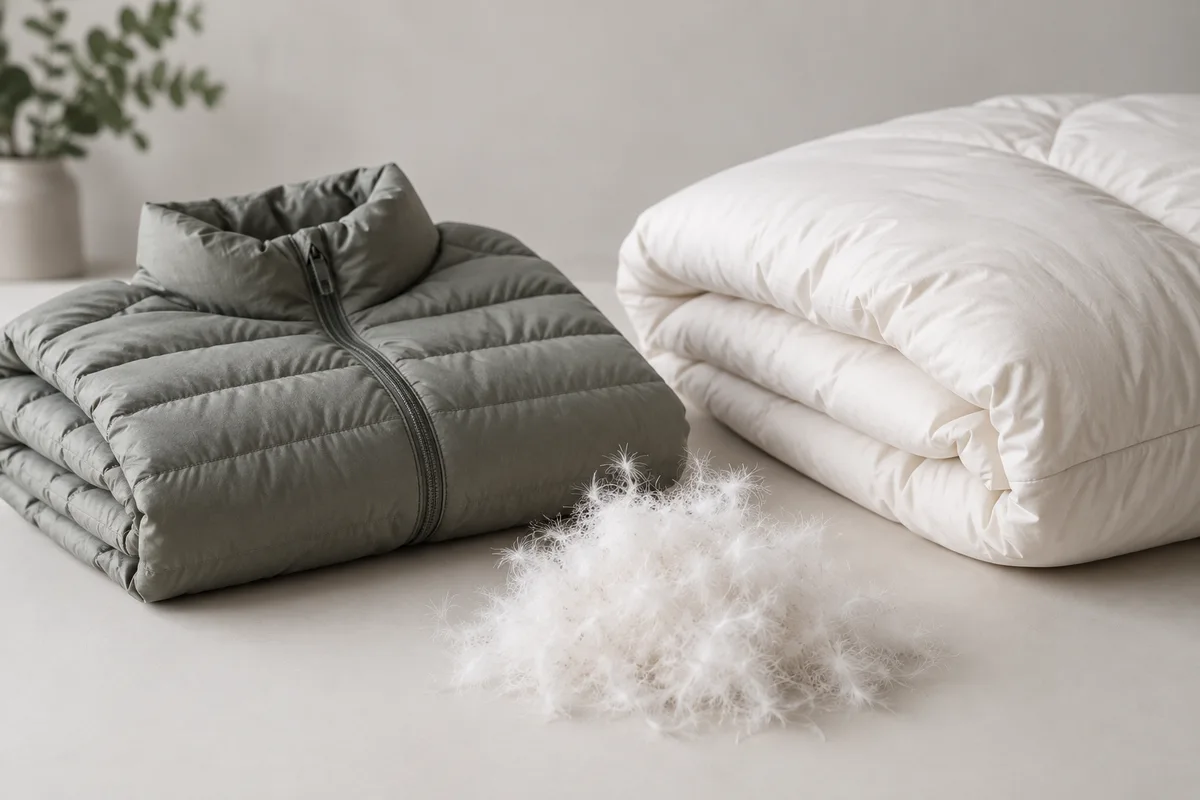
Where does recycled down come from?
The defining feature is a recovered input. Virgin down enters the filling supply chain without having been recovered as waste; recycled down gives eligible recovered material another use. A recycled description alone does not identify a country, collection network or previous product. The input category and supporting records give the sourcing team a clearer starting point.
Textile Exchange’s recycled standards accept qualifying pre-consumer and post-consumer inputs. These are categories of origin, not grades of quality. Neither tells you how much down cluster is present or whether a filling meets your finished-product brief.
Post-consumer inputs
Used duvets, pillows and garments can be sources of recovered filling after their intended use. Their availability does not mean every collected item is suitable. A buyer should ask how inputs are identified and unsuitable or mixed materials are handled. The collection country needs its own source records, separate from the supplier’s office address.
Pre-consumer inputs
Material diverted from manufacturing waste may qualify as pre-consumer input under the applicable recycled standard. Routine reuse within a process is not automatically an eligible recycled input. Request the classification and supporting evidence rather than treating every unused offcut or leftover filling as certified recycled material.
What is inside a recycled down filling?
Down clusters and feathers are different components
Down forms soft, three-dimensional clusters without the long shaft of a feather. Feathers have a shaft and a flatter structure. Recycled down filling can contain both. Content analysis identifies components by weight; specifying the test method and component definitions makes quoted percentages easier to compare.
Recycled content and down content use different classifications. For example, a hypothetical filling described as 100% recycled could still contain both down and feathers. That origin claim would not make it 100% down. Likewise, a shorthand composition such as 90/10 does not establish its recycled percentage. These are examples of how to read a brief, not CircuDown stock specifications.
At CircuDown, these distinctions guide B2B sourcing discussions for recycled down and recycled feather materials.
Duck, goose, white and grey describe other choices
Species analysis distinguishes duck and goose material; colour assessment addresses white and dark components. Neither replaces a composition or loft result. Colour can matter when filling shows through a light shell. Evaluate appearance using the intended fabric, and write any colour tolerance separately from the performance requirement.
For procurement, keep species, appearance, composition and origin on separate lines. This makes it easier to see whether two offers describe the same material. A buyer seeking a white goose filling should not have to infer species from the colour or recycled content from a blend name.
Practical sourcing note
“90/10 recycled down” is a useful starting point, but a comparable quotation needs more detail. A sourcing brief can specify duck or goose, white or grey, the target down content and component definition, fill power with its test method and units, and any recycled-content or certification requirement. Quantity, destination and relevant testing requirements help define the commercial and quality brief. Where a value is still undecided, mark it as open for discussion. This gives the supplier and buyer a shared basis for selecting samples and reviewing an offer; the final specification and supporting documents remain subject to agreement.
How is recovered filling prepared for reuse?
A typical route includes sorting recovered inputs, extracting the filling, separating material fractions, washing, treatment, drying and quality assessment. The sequence explains the concept; it does not document the actual processing of an offered lot. Ask the supplier which operations apply and how material identity is retained through them.
For acceptance, descriptions such as washed or sterilized need to be accompanied by relevant cleanliness and hygiene evidence, including the sample identity, method and acceptance criteria. Processing temperatures, treatment times and microbiological outcomes need process-specific evidence. This guide does not assign universal values or claim that CircuDown uses one fixed treatment route.
Where can recycled down be used?
Recycled down is a candidate filling for apparel, bedding and outdoor products when the agreed specification and finished construction are suitable. Start with the product requirement. A material name or laboratory loft number cannot, by itself, establish comfort, leakage resistance or a temperature rating for the finished item.
Jackets: warmth, weight and shell compatibility
For a jacket, consider the intended use, fill weight, chamber design and shell alongside composition and loft. Review a sewn prototype before approving the filling. A fabric and filling combination that looks acceptable loose on a table still needs assessment in the actual garment, including seams and leakage.
Sleeping bags: evaluate the complete construction
A sleeping bag brief should identify the target product performance and the method used to assess it. Fill power measures loft under defined conditions; it is not a sleeping-bag temperature rating. Review filling quantity and distribution with the bag design rather than converting a fill-power number into an unsupported warmth claim.
Bedding: distinguish insulation from support
A duvet and a pillow need different design discussions. For a duvet, review loft, distribution and the intended thermal result. For a pillow, add support, feel and the role of feather components. Compare candidates in the intended casing and construction instead of assuming the highest down percentage is the right answer for every bedding product.
What proves origin, quality and certification?
A recycled down buyer should evaluate origin evidence, material test results and application approval separately. Fill-power comparisons need the reported units, method and conditioning: handling and conditioning can affect the result. Composition analysis supports the composition claim; recycled origin and finished-product warmth need their own supporting records and assessments.
GRS addresses recycled material and chain of custody, with additional processing requirements. RDS addresses animal welfare and traceability in its down supply chain; it is not evidence of recycled content. Textile Exchange also distinguishes a supplier’s scope certificate from certification of the goods ordered. Check current scope and the transaction certificate applicable to the shipment before approving a certified claim.
| Buyer question | Evidence to review |
|---|---|
| Is the origin claim supported? | Input classification, recycled percentage and chain-of-custody records linked to the material. |
| Does the material meet the brief? | Composition, loft and relevant cleanliness reports with sample identity, methods and agreed limits. |
| Are the ordered goods covered? | Valid certificate scope, covered product and activity, and applicable transaction documentation. |
| Will the product work as intended? | Approval of the filling in the intended shell and construction, with product testing where needed. |
What should go into a first sourcing brief?
Send the requirements you know and mark the rest as undecided. Purchasing, materials and quality teams can then resolve the open points against the same brief. Avoid copying an unexplained number from a competitor’s label: the method, construction and claim basis may be different.
- End product and intended use: jacket, duvet, pillow, sleeping bag or another construction.
- Duck or goose preference, white or grey appearance, and any shell show-through concern.
- Target down content, component definition and acceptance tolerance, if already specified.
- Fill-power target with units, test method and conditioning; attach the original wording if available.
- Recycled-content target, input category, certification and traceability requirements.
- Relevant cleanliness, hygiene and finished-product tests required by your quality team or destination market.
- Estimated quantity, destination, sample needs and requested delivery timing.
Discuss recycled down with CircuDown
At CircuDown, we focus on recycled down and recycled feather materials for B2B applications. CircuDown is a brand of Elly Feather & Down Product Co., Ltd. Our material pages separate duck down, goose down and feather options so you can start with the relevant family and then discuss your specification.
Use Request a Quote to share an existing specification or ask for help choosing one. You can include a sample request in the same inquiry. Send specification-sheet attachments separately to info@circudown.com; the website form sends contact details and notes, not files. Specifications, availability, documents and delivery timing must be confirmed for the proposed order.
Questions, answered.
Is recycled down synthetic or vegan?
No. Recycled down is recovered animal-derived down. Recycled polyester is a different, synthetic material. If a filling combines them, identify each component and its percentage rather than treating the blend as entirely down.
Does 100% recycled mean 100% down?
No. Recycled percentage describes origin; down percentage describes composition. A fully recycled filling can contain down and feathers. Ask for both values and the basis used to verify them.
Is recycled down automatically lower quality than virgin down?
Origin alone cannot rank two lots. Compare composition, loft under the same test conditions, relevant cleanliness results and suitability in the intended product. Do not assume either origin guarantees a particular performance level.
Is recycled down hygienic?
Hygiene must be assessed from the processing controls and relevant test evidence for the offered material. Neither previous use nor a statement that material was washed establishes whether it meets your acceptance requirements.
Does recycled down always have GRS certification?
No. The description recycled down does not itself establish certification. Verify the supplier’s current scope, covered material and transaction documentation for the ordered goods before making a GRS claim.
Can I request material before I know the full specification?
Yes. Use CircuDown’s Help me choose a specification inquiry path, provide the end use and requirements you know, and leave unknown optional fields blank. The proposed material and order terms still need confirmation.
Further reading & source references
These primary references explain terminology and testing or certification scope. Confirm the current method and applicable policy for your order; these links do not verify a specific CIRCUDOWN shipment.
Textile Exchange — recycled material standards ↗Textile Exchange — pre-consumer material definition ↗IDFL — down and feather structure ↗IDFL — composition, species and colour analysis ↗IDFL — explanation of down and feather tests ↗IDFL — fill power and conditioning ↗IDFL — jacket testing ↗IDFL — finished-product downproofness ↗Textile Exchange — Responsible Down Standard ↗Textile Exchange — scope certificates and ordered products ↗